
Eight hundred years are only the written part
The first document dates from the middle of the 12th century. People were probably digging here long before that. It was written down only once ownership and dues were at stake.
Nine chapters
around 1140 to todayA mountain is given away
Count Arnold von Greifenstein and his wife Adelheid transfer the „mons argenti“ — the silver mountain of Villanders — to the newly founded Neustift Abbey near Brixen. This is the first reliable record that a mine existed here.
Monasteries were reaching for production sites at the time, as was usual then. Neustift Abbey itself had been founded in 1142, by Blessed Hartmann and the Säben burgrave Reginbert. The Villanders silver was a considerable gain for the young abbey.
In 1177 Emperor Frederick I Barbarossa confirmed the donation in Venice — only through this did it become legally binding. Twelve years later he enfeoffed Bishop Heinrich III of Brixen with the silver mines; half the yield had to go to the emperor.
On 21 December 1217, at the imperial diet in Nuremberg, King Frederick II granted the Brixen bishop Bertold I von Neifen all the silver, metal and salt mines in his territory — full rights over mining. On 7 December 1452 Frederick III endowed the prince-bishopric with further mining privileges. The bishop at the time was Cardinal Nicholas of Cusa.
Why there is a castle in the Tinnetal
From 1027 the Tinnebach separated the dioceses of Brixen and Trent, the counties of Bozen and Norital, later the courts of Villanders and Latzfons-Verdings — and the prince-bishopric of Brixen from the County of Tyrol.
The catch: a stretch of the southern bank belonged to Brixen, and that is exactly where the ore deposits lay. Brixen and Tyrol met right in the middle of the mining area. Every new ore find made the border question urgent again, and led to new surveys and new boundary stones.
That explains why a fortress was built in this remote area at all: Garnstein Castle, on a rocky spur where the Plankenbach flows into the Tinnebach. Around 1300 the mine itself was named after this castle — Garnstein mine, or Gerstein. Klausen was given its own mining court.
Where the Pfunderer Berg gets its name
A document from 1330 states that Heinrich had granted permission „ze paun und ze arbeiten den ganch des silberaereztes üf dem perg ze Vilanders, da unten an stözzt der hof ze Pfunt“.
The Phunt farm lies on the eastern side of the mountain at 1315 metres and is first mentioned in a document in 1332. The mountain too once bore this name. From it came the Pfunderer Berg.
When a cardinal and a duke quarrel over ore
The mines were fought over particularly fiercely under Cardinal Nicholas of Cusa, Bishop of Brixen from 1450 to 1464. He was in constant conflict with Duke Sigismund the Rich in Coin, in the mining question too. Mines were seized by force, because both sides invoked old agreements.
Only with Cusa’s death in 1464 did calm return. His successors gave way: the mine is leased to mining operators, the income split half and half.
The territorial prince took two things: the Fron — every tenth bucket of the ore mined — and the Wechsel, a levy on the smelted silver. For the perpetually cash-strapped territorial princes this was vital.
The operators were Hans and Georg Stöckl from Schwaz, who owned a smelting works with two furnaces near Klausen, and Hans Paumgartner from Augsburg. In 1513 they reminded the territorial prince that they were trying to raise up the „small and disorderly mine“ on the Pfunderer Berg — by now „several hundred men“ were employed there.
Augsburg buys in
On 1 January 1522 Jakob Fugger bought Hans Stöckl’s half of the Klausen and Rattenberg mining and smelting business, for 3,000 gulden. Jakob and after him his nephew Anton had these mines worked together with Paumgartner: Landskron, St. Elisabeth, Unser Frauen Himmelfahrt, Heilig Kreuz, St. Georg im Rosstal, St. Daniel, St. Stephan and St. Christoph zu Garnstein.
In 1527 Anton Fugger additionally bought shares in St. Elisabeth and St. Anna. For storage the Fuggers kept an ore store at the southern end of Klausen, „auf der Frag“.
The Fuggers’ focus nevertheless always remained Schwaz; Klausen was secondary. One name has survived: the adit through which the tour runs today has been called St. Elisabeth since Fugger times.
Four centimetres a day
Blasting came late. Until then practically every adit was cut with hammer and chisel — a miner managed about four centimetres a day.
The enemies were water, ventilation and darkness. There was hardly any technical literature, so the miners worked out their drainage and ventilation systems themselves.
In front of almost every adit stood a sulphur furnace in which the ores were pre-smelted; the result was called Röster. Such a furnace held around 2,000 buckets of raw ore and burned for 17 to 18 weeks, depending on the weather. The Röster went along the ore trail to Klausen, to the big ore store on the Frag, from there in sacks on carts — Grateln — to the Sulferbruck smelter at the entrance to the Villnöss valley. Six furnaces stood there: blast furnace, bent furnace, assay furnace, zinc furnace, roasting reverberatory furnace, lime kiln.
Annual yield: around 16 tonnes of copper ore and 100 kilograms of silver. The ore trail that hikers walk today was the works road.
The monastery on Säben was paid for with this silver
The Jenner family came from Savoy and had been settled in Klausen since the 16th century. Matthias Jenner was born in 1631, the son of the mayor and Bear innkeeper Christoph Jenner. He studied theology in Innsbruck, Graz and Vienna and took his doctorate in Perugia in 1662.
From 1659 to 1677 he was parish priest and dean in Fügen. There he came into contact with mining for the first time. He had prospecting done for gold in the Hohe Tauern and for silver at the Villanders Mine — and helped the mine to a second, smaller heyday.
In 1677 he became hospital administrator and dean in Klausen, in 1679 a canon in Brixen. From 1681 he put into action his plan to found a monastery on Säben. The necessary capital came mainly from the mine’s proceeds. He brought Benedictine nuns from Nonnberg near Salzburg — two of his cousins had entered there. In November 1686 the founding charter was issued.
In 1688 Jenner also had the new smelter at Sulferbruck built, and the Seebegg residence in Klausen, the mining office. He died in 1691 and lies before the high altar of the Säben abbey church. His last words are recorded: „Seeben, Seeben.“ His brother Michael carried on the business and was raised to the nobility in 1696.
The little miners’ church
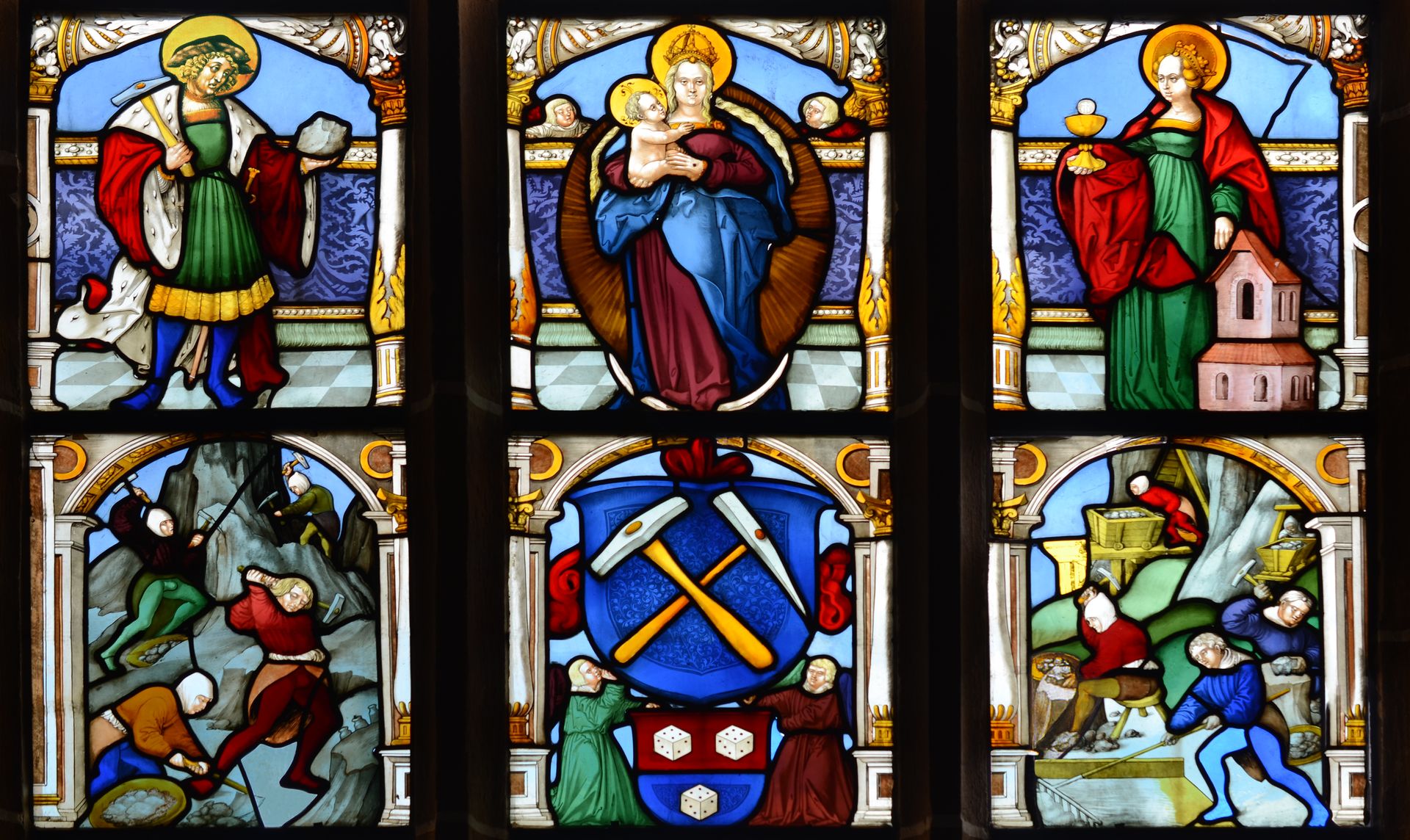
In 1722 Prince-Bishop Kaspar Ignaz von Künigl consecrated a portable altar for the miners on the Pfunderer Berg — an altar on which mass could be read in the open air as well. In 1724 the Villanders parish priest blessed a first small chapel, built by the miners themselves, in honour of St Barbara.
In 1736 this first building was enlarged to its present size, with a bell tower. The consecration took place on 9 August 1749, to St Anne and St Barbara. Above the entrance the mining symbol is carved in stone: two crossed hammers.
Anyone who goes underground every day knows that coming back is not a given. The Barbara brotherhood was established in 1772; its members prayed daily for a good hour of death. The Barbara celebration in December still recalls this today.
Timber, flood, the end
Towards the end of the 16th century silver mining across Tyrol fell into crisis. On top of that came disputes between Paumgartner, Stöckl and Fugger. The death blow came from an imperial decree: almost no more timber could be felled. The forests around had been nearly cleared — a mine needed vast amounts of wood, for charcoal in forges and smelting furnaces and as support material in the adits.
At the end of the 18th century the mine went bankrupt and passed into state ownership; in 1785 it was declared a state domain. The annual output was then about 5 tonnes of copper, 25 tonnes of lead and 130 kilograms of silver. Between 1835 and 1838 a stamp mill was built in the Tinnetal — hence the field name Pucher —, in 1846 a crushing mill, in 1845 a new ore road to Klausen. In 1849, 130 men worked in five adits.
Then a storm swept the Tinnetal road away. It took fifteen years before Austria repaired it. Shortly before the First World War Austria finally abandoned the mine.
After the war it came into Italian ownership, and a new adit was driven: the Victor Emmanuel adit. In August 1921 one of the biggest storms in the area struck Klausen and destroyed the road and the stamp mill. The Italian state shut down operations. In the Second World War nine Italian miners and one German miner worked once more in the Franz and the Victor Emmanuel adits. They were the last.
What remains when the ore runs out
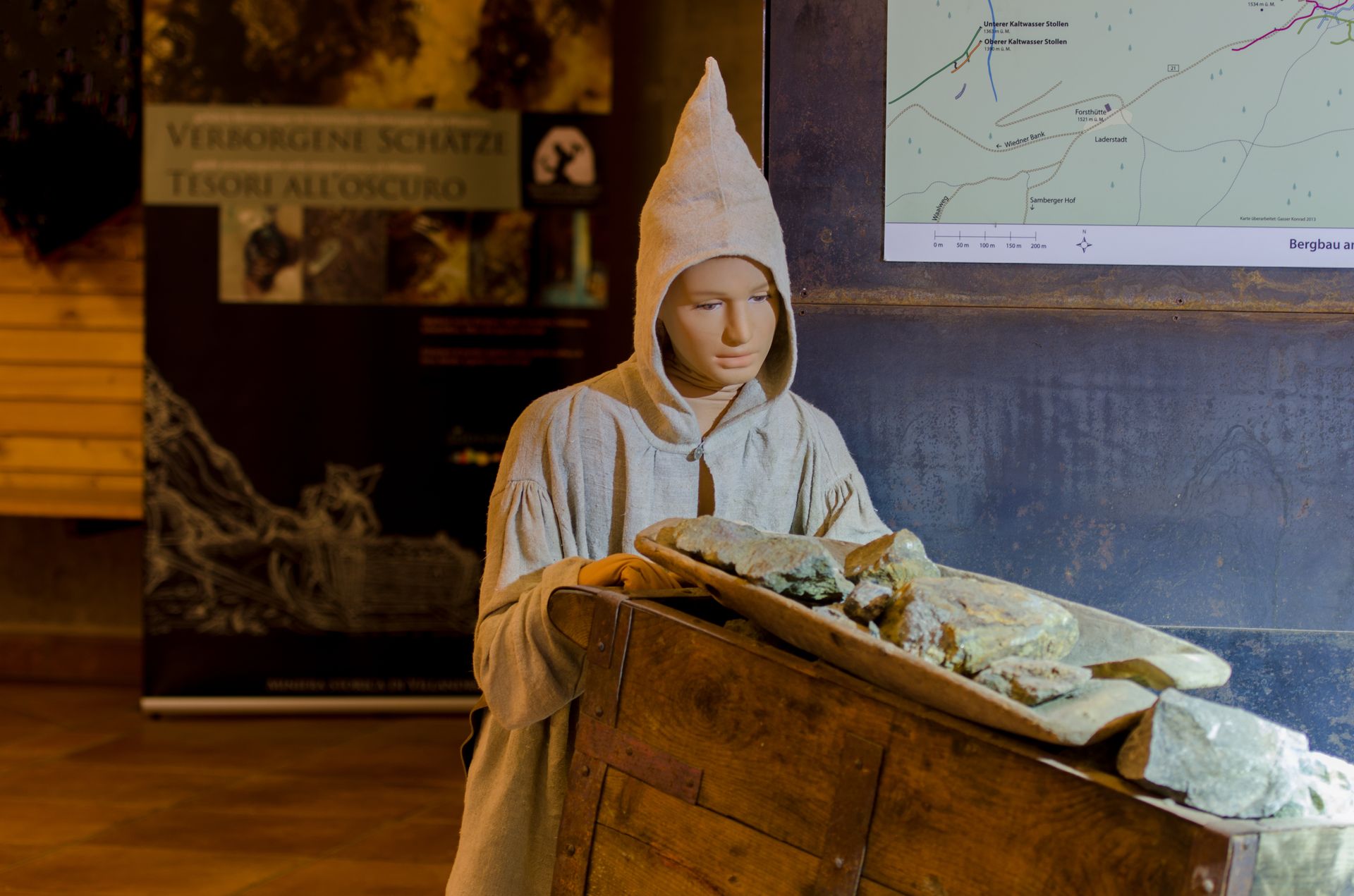
The Kultur- und Museumsverein Villanders has turned the disused workings into a show mine. Two of the sixteen adits can be walked: Elisabeth at 1300 and Lorenz at 1368 metres.
Around 331 tours a year, carried by volunteers who together put in some 3,840 hours. In 2024, 6,693 visitors came.
The association behind it
Since 1997The mine belongs to no company. It is run by the Kultur- und Museumsverein Villanders — voluntarily, since 1997.
Alongside the show mine the association also runs the Kulturtreff Rotlahn and a yearly programme from cabaret evenings to the Lorenzi festival. Becoming a member is open to anyone. More about the association →