
What the mountain yields
Silver, lead, copper, zinc — and a little gold. What lies in the rock here, which rocks make up the mountain, and the stories that surround them.
The ores
What was minedThe greatest value did not lie in silver itself but in galena: one tonne of it yielded three to six kilos of silver. Chalcopyrite gave considerably less, 0.4 to 1.7 kilos per tonne. Gold occurred too, but finely dispersed in pyrite and sphalerite, above all in the Kreuz, Elisabeth and Nikolaus adits.
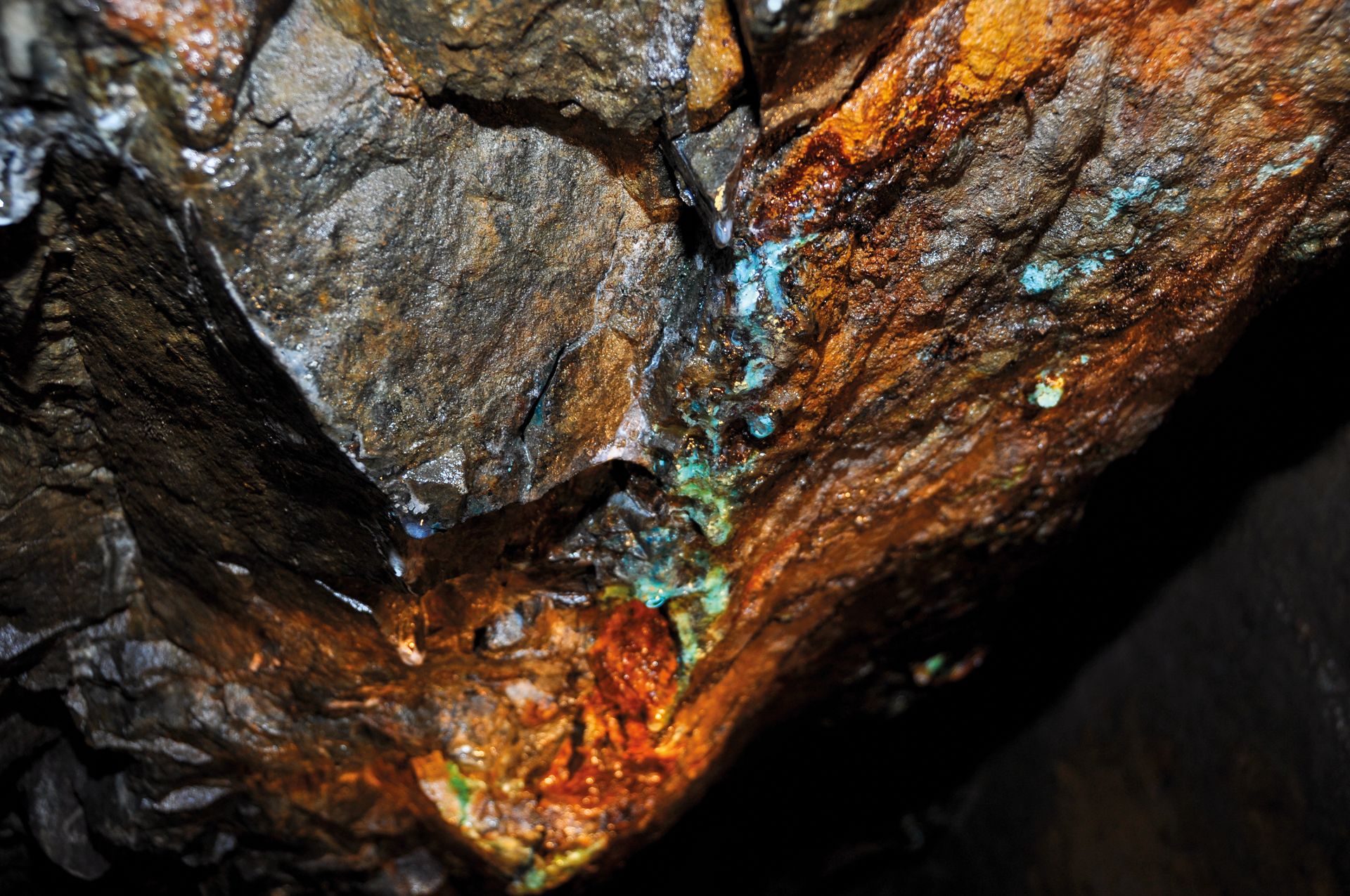
Galena
Lead sulphide, with a silvery metallic lustre
3 to 6 kg of silver per tonne
The actual reason why people dug here
Chalcopyrite
Brass yellow, often iridescently tarnished
0.4 to 1.7 kg of silver per tonne
Supplied mainly copper
Gold
Finely dispersed in pyrite and sphalerite
Kreuz, Elisabeth and Nikolaus adits
Never in nuggets, always bound up in the rock
The rock
GeologyThe mountain is not made of a single piece. Four rock zones meet here, and the ore veins sit exactly at the transitions.
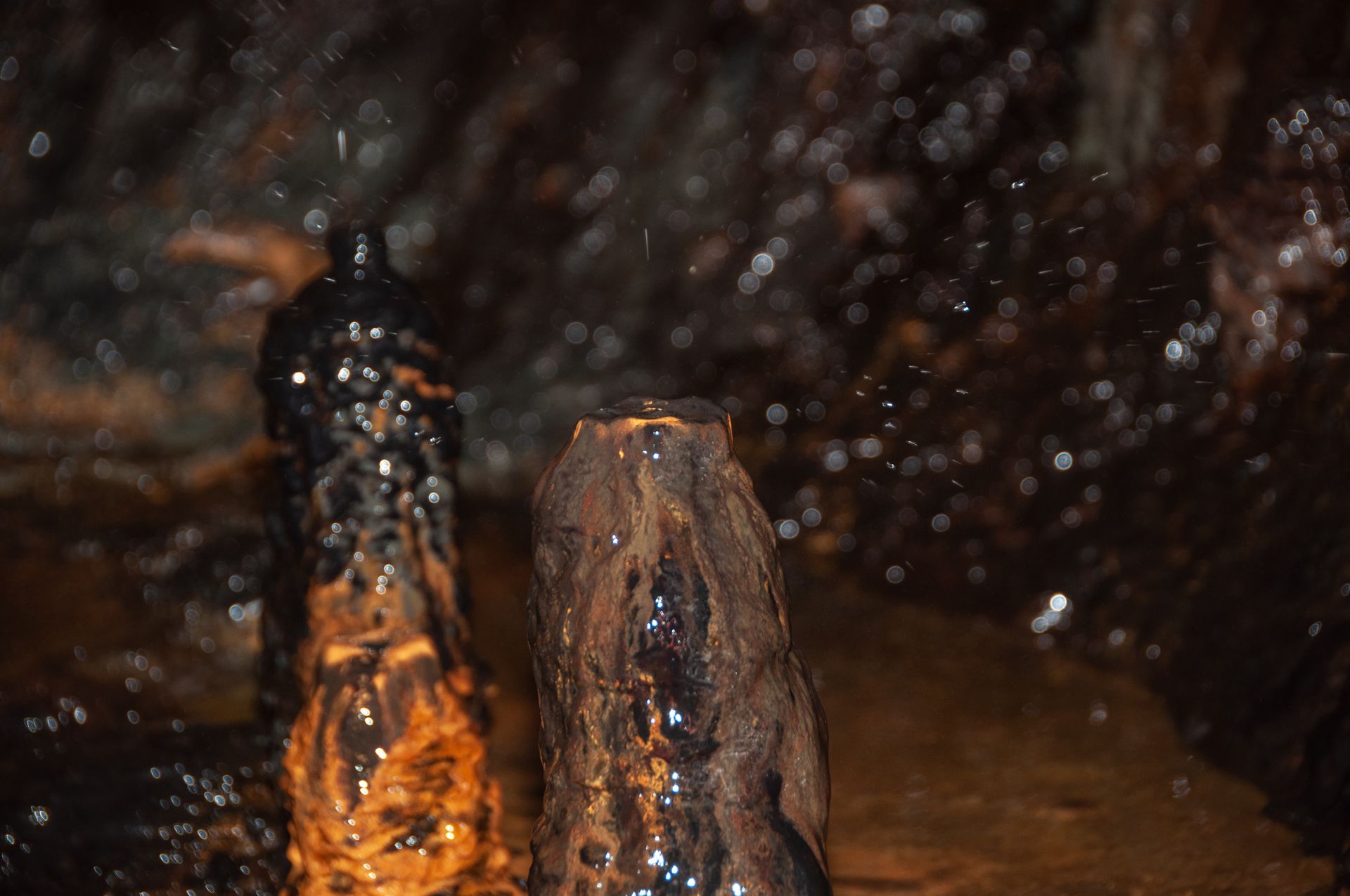
Four zones
Brixen quartz phyllite — mica schist, finely foliated
Klausenite — a diorite, dark and massive
Feldstein — the zone in which most of the stopes lie
Quartz mica schist — in the eastern part
Footwall, middle, hanging wall
Three veins run through the deposit.
Down as far as the Georg adit, only the footwall vein is of economic importance.
Only at depth do the middle and hanging-wall veins develop.
They are displaced by thrust and overthrust planes — the miners simply called them walls.
Mineral cabinet
Eight piecesA small selection of what was found inside the mountain. The collection can be seen in the museum.
Galena
PbS
Cubic, lead grey, with mirror-like cleavage faces. The silver carrier of the district.
Chalcopyrite
CuFeS₂
Brass yellow, often iridescently tarnished. Supplied copper and some silver.
Sphalerite (zinc blende)
ZnS
Brown to black, with a resinous lustre. Carries finely dispersed gold.
Pyrite
FeS₂
Fool’s gold. Cubes with striated faces, often gold-bearing.
Quartz
SiO₂
The vein material in which the ores sit. Milky to clear.
Siderite
FeCO₃
Iron spar, light brown, rhombohedral. A frequent companion of the veins.
Tetrahedrite
(Cu,Fe)₁₂Sb₄S₁₃
Grey-black and unremarkable — but it can contain a great deal of silver.
Malachite
Cu₂CO₃(OH)₂
Bright green. Forms where copper ore weathers in the air.
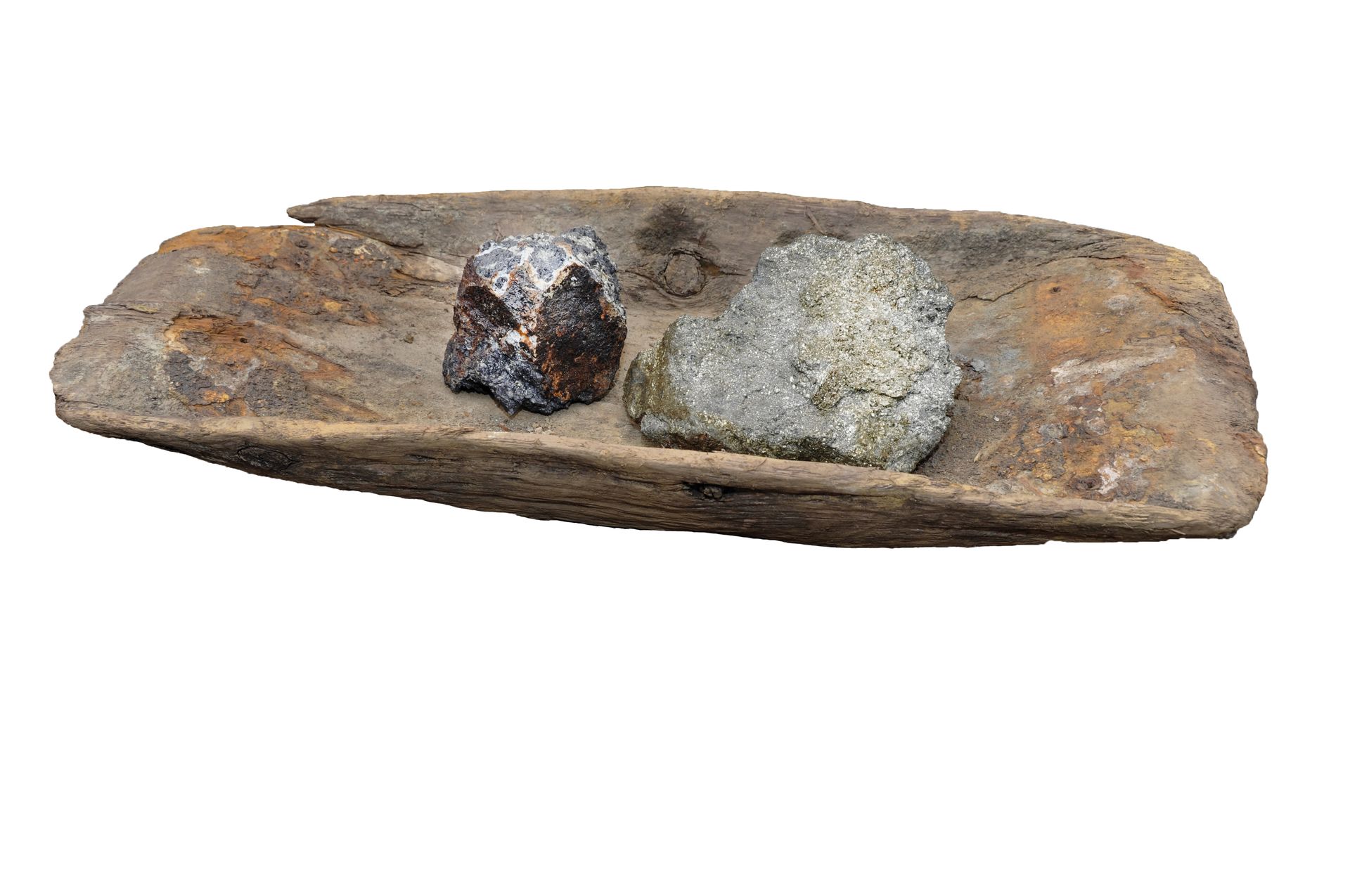
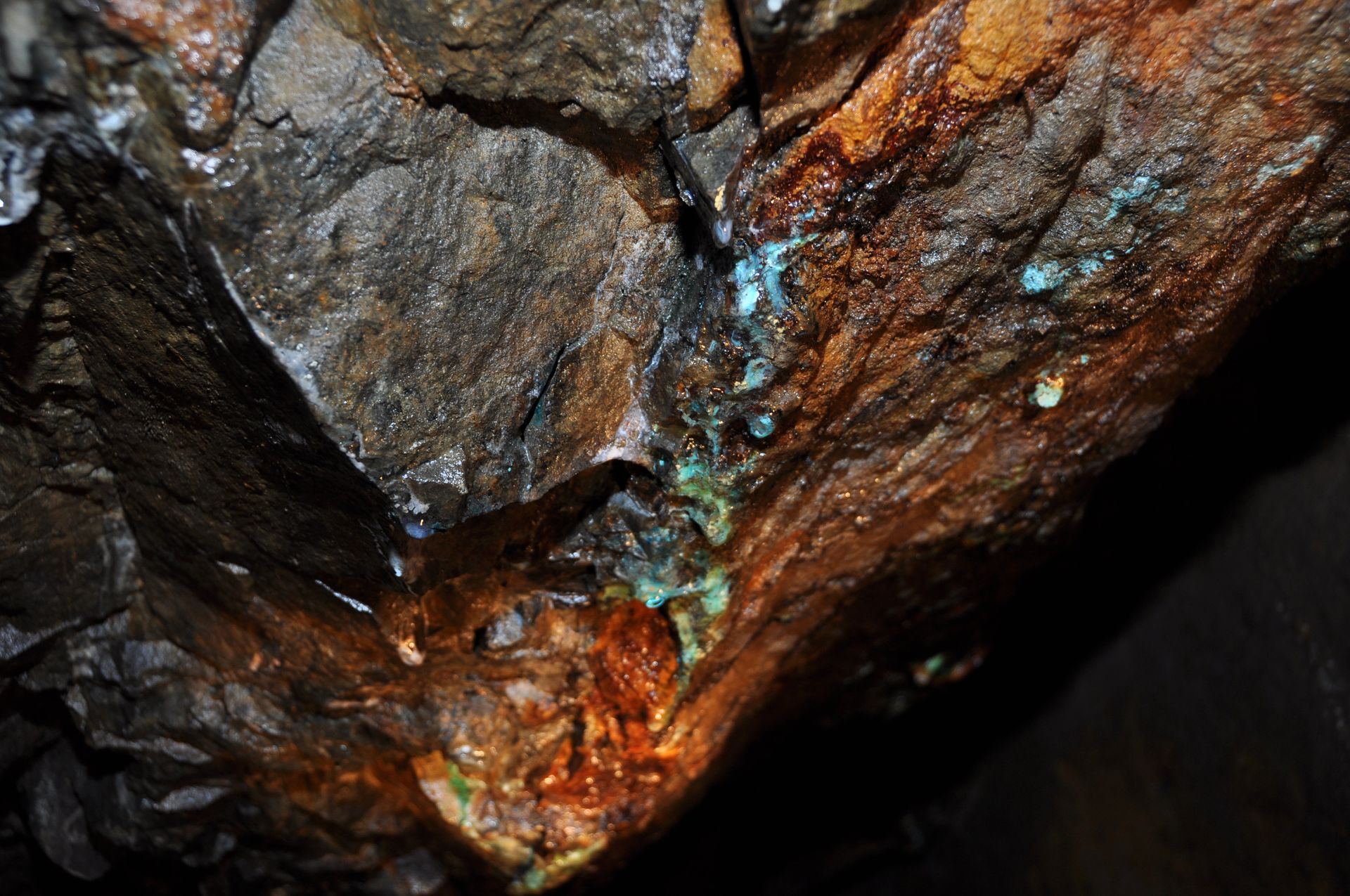
Formulas and identifications still have to be checked against the association’s collection.
Over 75 mineral species
The complete listOver 75 mineral species have been recorded in the adit network. The miners had their own names for some of them: black sphalerite speckled with chalcopyrite was called Tattermannl-Erz, after the fire salamander.
Gold · Graphite · Copper · Sulphur · Silver
Acanthite · Stibnite · Argentite · Arsenopyrite · Bismuthinite · Boulangerite · Bournonite · Chalcopyrite · Chalcocite · Covellite · Cubanite · Dyscrasite · Freibergite · Galena · Gudmundite · Heteromorphite · Jamesonite · Marcasite · Molybdenite · Polybasite · Pyrargyrite · Pyrite · Pyrrhotite · Sphalerite · Stephanite · Tetrahedrite · Valleriite
Fluorite
Anatase · Cuprite · Goethite · Hematite · Ilmenite · Limonite · Magnetite · Manganomelane · Pleonaste · Pyrolusite · Quartz · Rutile · Spinel
Aragonite · Aurichalcite · Azurite · Brianyoungite · Calcite · Chalcophanite · Cerussite · Dolomite · Hydrozincite · Malachite · Siderite · Smithsonite
Alunite · Anglesite · Anhydrite · Baryte · Beudantite · Brochantite · Chalcanthite · Celestine · Cyanotrichite · Gypsum · Glaucokerinite · Carphosiderite · Langite · Linarite · Melanterite · Namuwite · Natroalunite · Nickelalumite · Plumbojarosite · Posnjakite · Ramsbeckite · Schulenbergite · Serpierite · Siderotil · Woodwardite · Wroewolfeite
Apatite · Erythrite · Mimetite · Pitticite · Scorodite · Turquoise
Adularia · Albite · Allophane · Andalusite · Apophyllite · Augite · Axinite · Biotite · Chabazite · Chlorite · Chrysocolla · Cordierite · Datolite · Delessite · Diallage · Dravite · Enstatite · Epidote · Garnet · Hedenbergite · Hemimorphite · Hornblende · Hypersthene · Kaolinite · Clinochlore · Corundum · Microcline · Muscovite · Oligoclase · Orthoclase · Pectolite · Plagioclase · Prehnite · Ripidolite · Schorl · Stilbite · Titanite · Tremolite · Tourmaline · Wollastonite · Zircon
List taken over from the old website — to be checked against the association’s collection before launch.
Three stories from the mountain
Some readingWhy the miners needed Saint Barbara
Miners worked in the dark, under tonnes of rock, with open flames and without any rescue service. Saint Barbara became their patron — legend has it that a rock closed in front of her as she fled from her father, giving her shelter.
On 4 December, her name day, no one went underground. People celebrated instead. That tradition outlived the end of mining: the Barbara celebration still takes place in Villanders today.
Goldenschön and the blue Norgg
The Norgg is a dwarf from the legends of the Eisack Valley — sometimes helpful, sometimes malicious, always there where people push into the mountain. The blue Norgg is said to have lived in the Pfunderer Berg district, and anyone who treated him well was shown where the ore was rich.
Anyone who angered him found nothing more. That was how miners explained why a vein suddenly went barren. Today one of the hiking trails on the mountain carries this name.
Hammer and chisel
Before there was explosive, progress came millimetre by millimetre: one miner held the iron — a chisel — against the rock, the other struck it with the hammer. After every blow the iron was turned a little further.
One metre of tunnel a year counted as a good performance. Anyone who sees the hand-cut side adits in the Elisabeth adit today can work out how many years are locked into these walls. The crossed tools became the symbol of mining — and are still in the association’s logo today.
Sixteen adits
Elevations and lengthsThe higher workings are the older ones. Work moved through the mountain at decreasing elevation — a peculiarity that the specialist literature expressly highlights.
Older workings, cut with hammer and chisel
| Adit | Elevation | Length |
|---|---|---|
| Fundgrube | 1436 m | 50 m |
| Heilig Kreuz | 1431 m | 60 m |
| Lorenz (visitor adit) | 1368 m | 1.240 m |
| Elisabeth (visitor adit) | 1300 m | 1.670 m |
| Georg | 1254 m | 1.270 m |
| Matthias | 1227 m | 1.670 m |
| Martin | 1186 m | 1.100 m |
| Nikolaus | 1177 m | 1.120 m |
| Andreas | 1159 m | 600 m |
| Barbara | 1133 m | 1.450 m |
Later workings, driven with black powder
| Adit | Elevation | Length |
|---|---|---|
| Kassian | 1078 m | 1.320 m |
| Katharina | 1025 m | 1.800 m |
| Theresia | 965 m | 1.650 m |
| Franz (formerly Maximilian) | 915 m | 650 m |
| Vittorio (Victor Emmanuel) | 884 m | 250 m |
| Hischlegg | 843 m | 160 m |
Elevations according to the association’s board, lengths according to the old mine list. Together around 25 kilometres of tunnel.
Two things that explain the mountain
GeologyCross faults
Ore veins vanished in the middle of a drive. Cross displacements in the rock shifted them by metres, and nobody knew where. That is why the adit network is so full of turns: people were searching for the vein again.
The Seeberg district
On the Villanders alpine pasture, at 2,050 metres, lies the highest district — probably older than the mine itself. There you find a prehistoric smelting site, walled adit entrances and waste heaps. The stream flowing down from the three mountain lakes is still called Knappenbach today.
Further reading
LiteraturePošepný, F. (1880): Die Erzlagerstätten am Pfundererberg bei Klausen in Tirol. Archiv für practische Geologie 1, 441–487.
Schnorrer, G. / Verant, K. (1998): Der Bergbau am Pfunderer Berg bei Klausen in Südtirol und seine Minerale. Lapis 23 (2), 13–30.
Exel, R. (1998): Lagerstättenkundliche und montanhistorische Erhebungen über den Erzbergbau in Südtirol. Ber. Geol. Bundesanst. 42.
Mair, V. (1996): Die Kupferbergbaue von Stilfs, Eyrs und Klausen. Der Stoansucher 10 (1), 38–44.
Andergassen, L.: Kirchen in Villanders.